How to Stop Interview Proxy Fraud (When Someone Else Answers for the Candidate)
Learn how to detect and stop interview proxy fraud when someone secretly answers an interview for a candidate - using behavioral and forensic AI signals

In the age of remote work, geography no longer limits opportunity - but it’s also no longer a safeguard against fraud.
Every recruiter has heard this story: A candidate impresses everyone in a live video interview - answers fluently, codes swiftly, communicates perfectly. Then, on day one at work, a completely different person shows up.
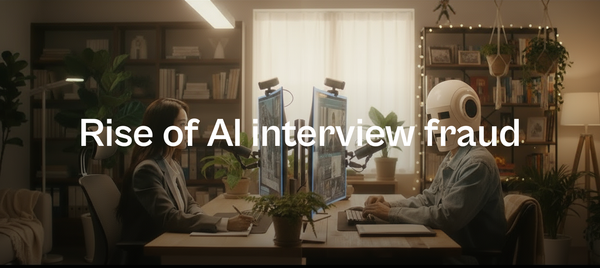
That’s interview proxy fraud - a growing problem where someone else secretly takes an interview on behalf of the real candidate.
It’s not just deceit. It’s a breakdown of trust in the entire talent ecosystem.
Candidate Caught cheating in interview
The Complications
Proxy fraud thrives on the same tools that make remote hiring possible - video calls, screen sharing, online tests, and asynchronous assessments.
Let’s understand why it’s hard to stop.
A. The remote layer hides physical identity
When cameras are optional, lighting is poor, or face visibility is partial, impostors can easily step in. Even with video, a low-resolution feed makes facial verification unreliable.
 Alex Orleans
B. The tech gap between recruiters and fraudsters
Fraudsters have evolved. They now use:
- Dual-screen setups to read AI-generated answers.
- Voice relay tools to disguise or mimic accents.
- Deepfake overlays or AI-voice filters to appear as someone else.
- Proxy marketplaces, where paid “experts” take interviews on behalf of candidates.
Meanwhile, most recruiters are still relying on intuition and human observation—tools that simply can’t scale.
C. The false sense of security
Even “proctored” interviews can fail to detect subtle cues—eye focus mismatch, inconsistent lighting, latency anomalies, or mismatched voice signatures.
Fraudsters rehearse these. Real candidates don’t.
D. The moral grey zone
Some candidates justify proxies as “help” or “coaching,” blurring ethical lines.
Recruiters, however, see it for what it is—a breach of authenticity and fairness.
 Luciano Bargmann
Signs of Interview Proxy Fraud
Detecting proxy behavior means recognizing both human irregularities and technical fingerprints.
1. Visual mismatch
- Face mismatch between resume photo and live feed.
- Low lighting or strategically cropped frame hiding parts of the face.
- Lips not syncing perfectly with audio (delay or misalignment).
🔍 Sherlock visual cue: Face-geometry heatmap showing misaligned mouth region or irregular blink pattern.
2. Voice inconsistency
- Voice pitch or accent doesn’t match previous screening calls.
- Low or flattened prosody range due to synthetic modulation.
- Echo or slight digital distortion suggesting external audio source.
🔍 Sherlock visual cue: Prosody entropy graph — inconsistent rhythm, high modulation noise.
3. Interaction behavior
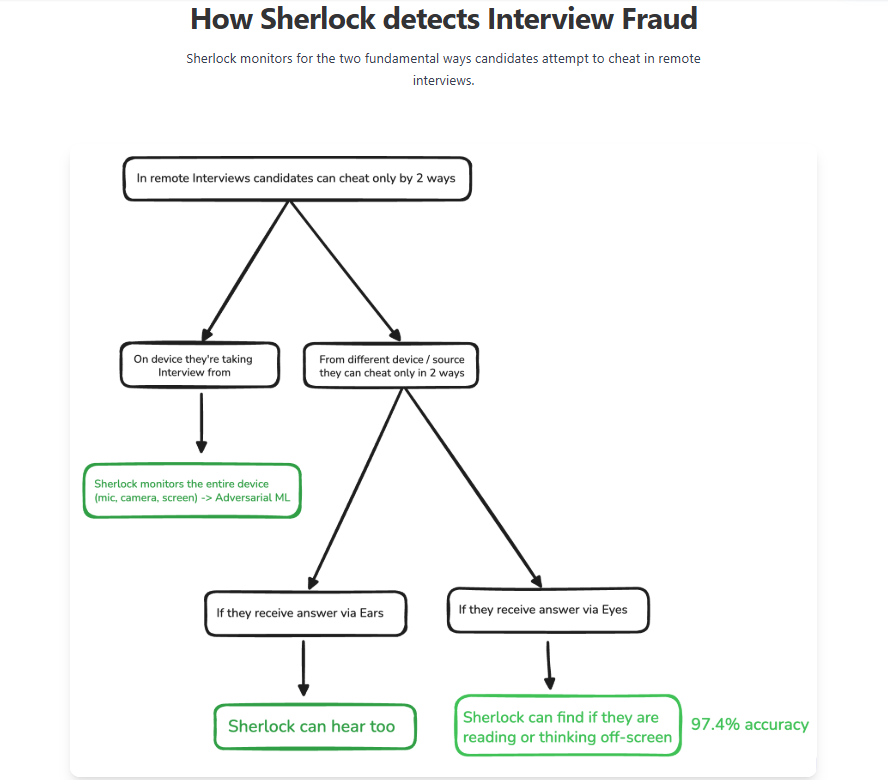
- Candidate looks off-screen frequently (reading from another monitor).
- Pauses unnaturally before answering.
- Avoids turning the head, keeping a “perfect front-facing posture.”
- Hesitates or freezes when asked spontaneous follow-ups.
🔍 Sherlock metric: Gaze entropy below normal human baseline = reading or external help.
4. Environmental inconsistency
- Background blur or virtual backgrounds concealing physical environment.
- Audio from multiple devices (delayed voice input).
- Multiple mouse movements detected (someone else controlling screen remotely).
🔍 Sherlock telemetry: Parallel pointer activity or tab-switch logs.
How to solve?
Stopping proxy fraud requires a multi-layered defense—not just visual verification, but forensic, behavioral, and systemic controls.
A. Identity Verification That Actually Verifies
Start before the interview begins.
- Ask for government ID upload or LinkedIn verification during scheduling.
- Match live facial geometry with the submitted ID photo (AI-based).
- Re-verify before every interview stage—not just once.
🔍 Sherlock feature visual: “Identity Match Confidence: 98% — verified via facial vector mapping.”
B. Behavioral Baseline Checks
During early calls, record voiceprints, prosody, and blink frequency to create a behavioral fingerprint.
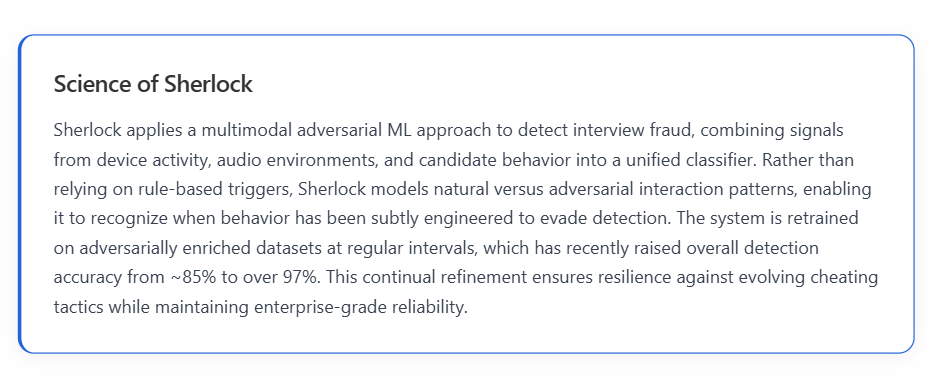
Sherlock’s models then compare these patterns in future interviews—flagging anomalies automatically.
🧠 Humans can fake answers. They can’t fake micro-behaviors.
C. Continuous Presence Tracking
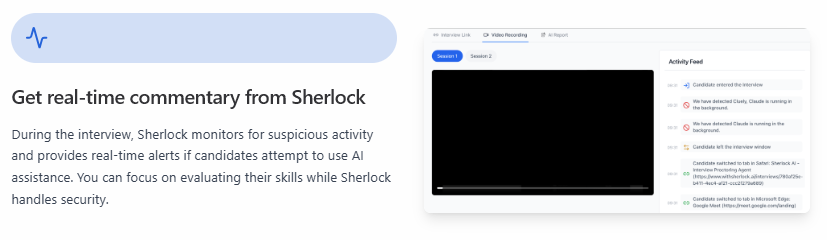
Instead of random proctor snapshots, use continuous signals like:
- Gaze variance (is attention authentic?)
- Window telemetry (is the user alt-tabbing?)
- Latency entropy (is the speech delay too uniform?)
By leveraging these real-time, privacy-preserving signals, Sherlock verifies cognitive authenticity—ensuring the person interviewed is genuinely engaged, not remotely assisted.
D. Zero-Trust Interview Architecture
Just as cybersecurity adopted zero trust, hiring needs the same mindset.
Assume every remote interview can be compromised, and build layers of validation:
- Verify identity (before).
- Monitor behavior (during).
- Audit forensic logs (after).
This triad ensures accountability across every step of remote hiring.
E. Educate, Don’t Just Enforce
Finally, prevention isn’t just about detection—it’s about culture.
Train recruiters to recognize subtle signs.
Educate candidates that integrity violations will be detected automatically.
Build a trust-first message: “Our systems verify authenticity so genuine candidates always stand out.”
 Sayan Gupta
5. The Bigger Shift
Interview proxy fraud isn’t just a tech challenge—it’s a philosophical one.
It tests whether companies can trust what they see and hear in a digital-first world.
The goal isn’t to punish—it’s to protect trust.
AI doesn’t replace human judgment; it amplifies it.
Tools like Sherlock exist to ensure that the person on camera is the person you’re actually hiring.
Call to Action
🔍 Want to see how Sherlock detects proxy interviews in real time?
Request a Demo and explore our facial vector mapping, gaze entropy, and forensic voice consistency features.